
The honest answer is: probably yes, but with conditions worth understanding before you commit. The value of launching an OpenCart eCommerce Mobile App has increased significantly in recent years, largely because native apps now consistently outperform mobile websites in user engagement and conversions. A modern OpenCart Mobile App Builder also makes app development faster and more affordable for store owners.
\That said, not every OpenCart store is in the same position. The answer depends on your traffic volume, your customer return rate, and what you are currently doing on mobile. Here’s what current market data indicates.
Customers can ask questions about products, order status, and store policies and get instant replies inside the app, at any hour. The AI chatbot reduces your support workload, keeps shoppers engaged, and helps move them from a question to checkout faster. You can read the full introduction and features of the OpenCart Mobile App Builder on Opencart Mobile website. ( Updated 30 September, 2026)
What the 2026 Mobile Commerce Numbers Tell OpenCart Merchants
Mobile devices now contribute approximately 62-64% of worldwide web traffic, while nearly 75% of eCommerce website traffic originates from mobile users. Those are not new trends, but the gap between how mobile traffic behaves on a website versus in a native app has grown sharper.
Mobile apps convert at nearly three times the rate of mobile eCommerce websites. App users view 286% more products per session than mobile web users. On average, mobile apps achieve conversion rates that are around 157% higher than those of mobile websites. The reasons behind these numbers are structural. Apps load faster, store user preferences, support biometric login, and reduce friction at checkout, and all of those factors compound into meaningfully better conversion performance.
Shoppers spend 201.8 minutes per month in shopping apps versus 10.9 minutes on mobile shopping websites, roughly 18 times more time. A customer who has your store on their home screen behaves differently from one who has to open a browser and navigate to your site. That difference is what the engagement gap measures.
Why a Responsive Website Is No Longer Enough for High-Returning Customers
A well-built responsive OpenCart theme handles the discovery problem adequately. New visitors who find you through search or an ad will land on a page that works on their phone. That part is solved.
The problem is what happens after. A shopper who bought from your store once has no particular reason to return to a mobile website; there is nothing holding the relationship open. Customers who install your app stay more consistently connected through features like push notifications, saved addresses, wishlists, order history, and one-tap reordering. That infrastructure is what drives repeat purchases, and a responsive website simply cannot replicate it.
A significant number of consumers do not use mobile shopping apps because they do not want more apps on their phones. This is the counter-argument worth taking seriously. Installing an app is a higher-friction ask than visiting a website. Merchants who rely heavily on one-time purchase traffic, gift stores, seasonal products, and impulse buys may find that the installation barrier reduces the channel’s effective reach.
The Specific OpenCart eCommerce Mobile App Capabilities That Change the Revenue Equation
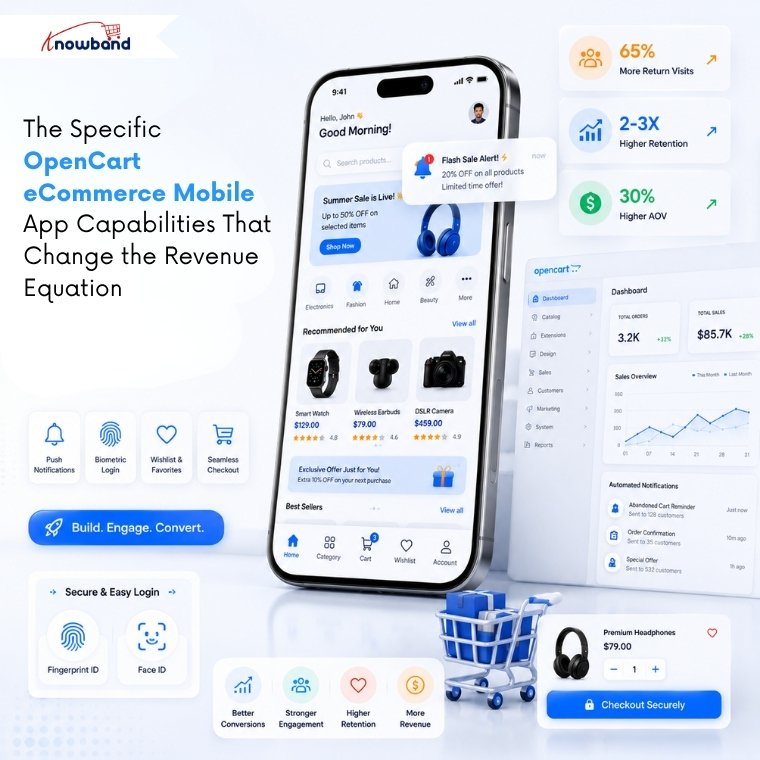
Push notifications are the most commercially impactful feature a native app adds. Push notifications increase return visits by 65%, and app users who opt in to notifications show 2-3x higher retention rates than those who do not. The Knowband OpenCart Mobile App Builder handles automated notifications for order confirmation, delivery status updates, and abandoned cart reminders, all configured from the admin panel without any development work required.
The average order value gap between app and mobile web is also real. Average order value in apps runs approximately $95 compared to $73 on mobile web, a 30% difference that reflects both the higher purchase intent of app users and the smoother checkout experience that removes hesitation at the point of payment.
Fingerprint and Face ID login removes the password barrier that causes login abandonment. A returning customer who can access their account with one tap is more likely to complete a purchase than one who has to recover a forgotten password mid-session. This is a native capability; a mobile browser cannot offer it without significant technical workarounds.
Who Does Not Need a Native App Right Now
If your OpenCart store does fewer than 500 monthly orders and most of your traffic is new visitors arriving from paid ads, a native app is likely premature. The investment makes most sense when you have a returning customer base large enough to install and engage with the app. Without that base, push notifications reach nobody, and the app sits largely unused.
Stores in the very early stages of building traffic should focus on mobile website performance first, load speed, checkout friction, and payment method variety. Those improvements affect every visitor regardless of device or channel. A native OpenCart eCommerce Mobile App amplifies the value of customers you already have; it does not reliably acquire new ones on its own.
What the Mobile App Building Process Actually Looks Like in 2026
The developer-cost barrier that used to make this decision straightforward has largely dissolved. Building a Flutter-based native app through a module-based approach takes 1-2 working days rather than months, and costs a fraction of custom development.
The Knowband OpenCart Android and iOS Mobile App Builder Module delivers both Android APK and iOS IPA files. Store admins configure the home screen layout using a drag-and-drop editor, banners, product grids, countdown timers, category tiles, and the OpenCart eCommerce Mobile App handles all synchronisation with the live OpenCart store automatically. Price changes, new products, and stock updates are reflected in the app the moment they go live on the website.
The latest version adds an AI chatbot integration (supporting ChatGPT, Gemini, Claude, and DeepSeek) and a VideoMate extension for product video carousels, both configurable from the admin panel without additional development. Additionally, Google AdMob integration also allows store admins to display in-app banner ads and generate additional revenue from app traffic.
The Honest Verdict for 2026
Around 70% of mobile shoppers in the U.S. prefer purchasing through dedicated eCommerce apps instead of mobile websites. That preference is not going to reverse. For OpenCart merchants with an established returning customer base, the conversion data, session time data, and AOV data all point in the same direction. A native app performs better than a mobile website for the customers who matter most to your repeat revenue.
For merchants still building their initial traffic, get the mobile website right first. Once you have returning customers worth retaining, the Mobile App for OpenCart by Knowband is the practical way to give them a channel that keeps them coming back.
For more such reads, you can visit:


