
A custom application development service provided by an agency may cost from $30,000 to over $150,000, depending on complexity, geography, and scope of work, with project completion normally taking three to nine months before any of it is put into the app store. That is not how things usually start for most OpenCart merchants. For this reason, using a module to build an OpenCart eCommerce Mobile App from an existing store changes those numbers considerably. The merchant receives a native Android and iOS application linked to their existing product catalog, checkout, and order system, without custom development. This mobile app builder for OpenCart by Knowband follows that model: install the module, share app requirements, and receive Android and iOS application files ready for store submission.
This article covers what you actually get, what it realistically costs to run, and how long the process takes.
What “without a developer” actually means
The phrase “no developer needed” requires some precision.
The use of a module means no need to hire developers who will code applications separately for Android and iOS platforms. The application logic, navigation, product presentation, shopping cart, payment process, and customers’ account management are controlled by the underlying technology, which in this case is Flutter. One and the same code generates native apps for both operating systems.
The remaining activities to be undertaken by the merchant to make the app operational include setting up the module settings, preparing app assets including icons and splash screens, reviewing the app created using the module, publishing it on Google Play and the App Store, responding to reviewers’ comments, and performing app maintenance.
As far as publishing an application on the App Store goes, some adjustments need to be made, as Apple has set certain guidelines.
So it would be right to state that the merchant can obtain a fully functional OpenCart eCommerce Mobile App without developing one, but there are still responsibilities around submission and maintenance.
What the process looks like
Three stages make up the process.
The merchant sets up and configures the OpenCart eCommerce Mobile App. Part of this involves linking store data to the app system, getting push notifications running via Firebase, and setting up branding, layout options, and other elements in the module’s admin panel.
Following that, the merchant shares the app requirements, including icons, screenshots, splash screens, app name, and any specific configuration details that will feed into the final build.
The generated Android APK and iOS IPA files, or equivalent submission files, are provided. Then the merchant will perform the work related to uploading the files and managing the app store accounts on Google Play and the Apple App Store.
According to the documentation, Firebase is used for push notifications, which is why a Firebase service-account JSON file is needed. Google Play and App Store accounts are also required before submission.
For a merchant with no prior app submission experience, this part can take additional time. The typical duration for an App Store review is one to three days for a standard submission but may go beyond that if there are questions from the reviewer. Google Play’s review period is relatively quicker but varies.
How long does it really take
Published estimates for custom app development typically run three to nine months. The module-based approach compresses that significantly, but realistic timelines depend on the merchant’s preparation.
If app assets, branding decisions, and Firebase configuration are ready in advance, the time from installation to receiving app files can be short. The submission process then adds time depending on store review outcomes.
A realistic estimate for a merchant doing this for the first time, including module setup, asset preparation, receiving the app, reviewing it, setting up store accounts, submitting, and getting through the review process:
Optimistic case: two to four weeks if assets are ready and both stores accept the submission on first review.
Typical case: four to eight weeks accounting for asset preparation, one revision round, and normal review timelines.
Extended case: up to twelve weeks if App Store revision requests require significant changes or if the merchant starts from scratch on all assets and accounts.
Those ranges aren’t specific to this module. They reflect the submission process for any app built for these platforms.
What it costs to build and run
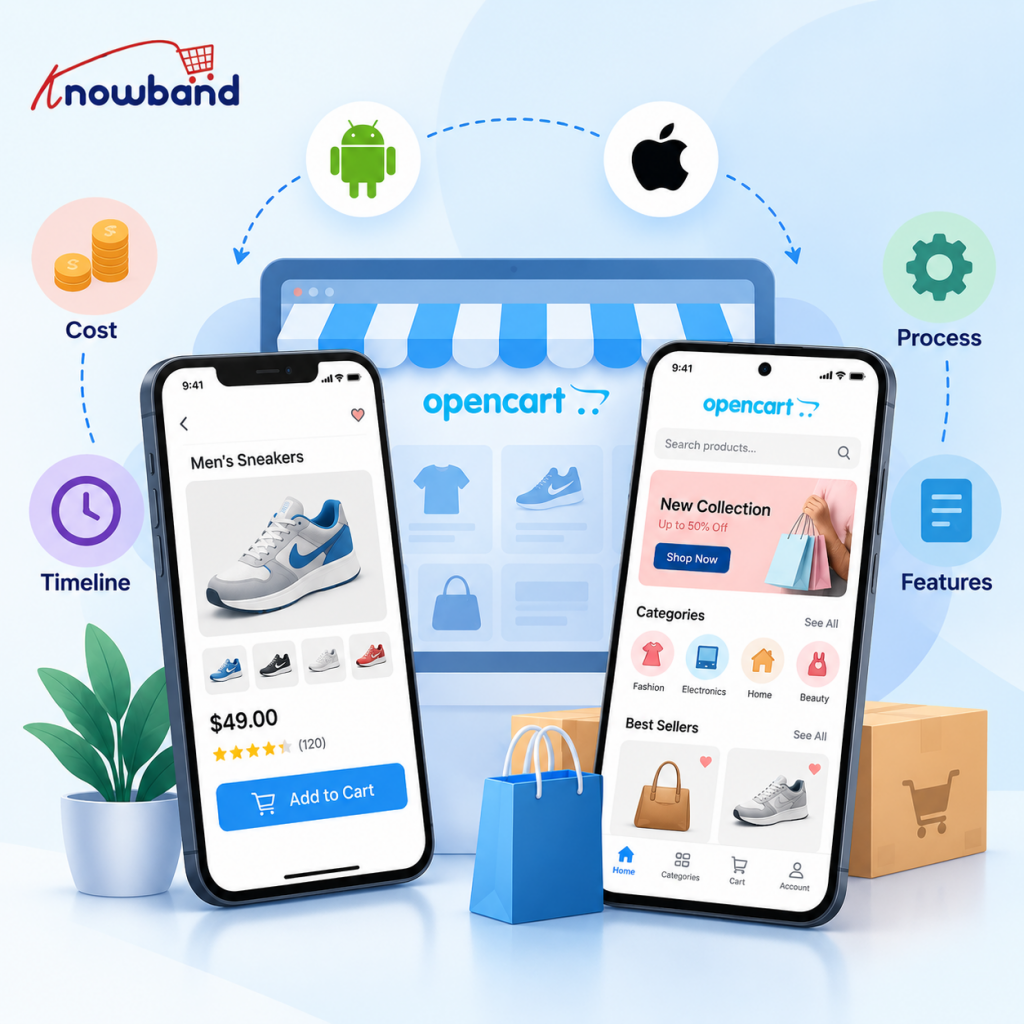
The module itself has a published price. The full cost picture also includes:
Cost of participating in the Apple Developer Program: Annual fee is $99 for submission of the application on the App Store.
Google Play Developer account fee: Flat one-time registration fee of $25.
Cost of Firebase: no cost for moderate volume of usage; tiered pricing depending on usage volume.
Cost of app assets: icon design, splash screen, and screenshots that may be either outsourced or produced internally.
Any revision work if the App Store or Play Store review requests changes.
The contrast with custom development is significant. Clutch’s app development pricing data places most reviewed projects between $10,000 and $49,999, with the average project across its wider dataset sitting at roughly $90,780. MobiLoud’s ecommerce research puts custom ecommerce apps in a wider band of about $30,000 to $250,000 or more, with annual maintenance adding a further $15,000 to $50,000. Neither figure includes platform review costs.
This module-based approach means that instead of paying for the upfront development, the merchant will pay for the use of the module, the annual Apple membership fee, and module updates if necessary because the OpenCart shop or module has been updated.
What you get: the features included
The OpenCart eCommerce Mobile App generated through the module includes features drawn directly from the OpenCart store.
Product catalog: categories, filtering, sorting, list & grid views, product pages, and image gallery. The application makes sure that the products are always up to date by connecting with the store in real-time synchronization mode.
Shopping process: product search, wish list, cart, and checkout. Guest checkout is supported, and shipping methods and payment methods come from the existing store setup.
Customer accounts: multiple login methods, including social login and one-time password options, are documented. Order history, order details, and delivery information are available on the account page.
Push notifications: notifications of orders placed, order status, and notifications of abandoned carts. The admin panel also allows manual push notifications to app users.
Additional functionality: WhatsApp chat support, multi-language and RTL support, and AI chatbot integration for product queries and order support are listed on the product page.
Customizable home screen layout which consists of banners, categories, product blocks, and recently viewed products.
The compatibility range listed on the product page covers OpenCart versions from 2.1.x to 4.x.x, with 4.8 as the latest supported release.
What are you missing without a module solution?
Understanding the limitations matters as much as knowing the features.
A module-based app cannot include functionality that falls outside the system. Non-standard custom checkout flows, payment integrations that the module does not cover, specific animation or interaction patterns, or deeply custom product configurators would need development work on top of the module.
The app design follows the module’s available templates and layout options. Deep visual customization beyond what the admin settings allow would require either working within those constraints or commissioning additional development.
Updates to the app depend on the module update cycle. If OpenCart releases a significant platform change or the App Store requires changes to the app binary, the merchant needs to go through the update and resubmission process. That’s not unusual for any app, but merchants should factor it into their operational planning.
The Flutter framework and what it means for app quality
Flutter is an open-source Google framework for the development of Android and iOS applications using a single codebase.
It compiles to native code rather than relying on a JavaScript bridge or WebView wrapper, which is the main reason its performance is generally closer to a native build than to a hybrid one.
This is worth noting because some earlier app builders produced hybrid or web-based apps with noticeable differences in responsiveness. A Flutter app is written once and shipped to both platforms while still being distributed as a native binary.
For a merchant, that should mean acceptable performance across the core commerce functions such as browsing, searching, adding products to the cart, ordering, and monitoring orders.
Should you connect an existing OpenCart store or start fresh
The module is intended for an existing OpenCart store, not a new one created just to have an app.
Where the store already has working products, categories, payment methods, shipping rules, and customer accounts, the app can draw on that directly. Synchronization keeps product information, stock, and pricing current. This is one area where the Knowband approach works well: the Mobile App for OpenCart reflects the live store rather than requiring a separate catalog to be built and maintained.
If the store’s catalog is not correct in terms of missing descriptions, inconsistent categories, or wrong prices, then these issues will appear in the app as well. It is necessary to do a product title, description, image, category, stock, and price audit before creating the application.
When a module-based OpenCart Mobile App Maker makes commercial sense
Not every OpenCart store needs a mobile app immediately.
The investment in time and ongoing maintenance is worth considering against the potential return. Some situations where the approach tends to make more commercial sense:
The store already has a mobile traffic share that isn’t converting at desktop rates.
The business has a meaningful share of returning customers who purchase repeatedly.
Categories such as fashion, beauty, food, or accessories, where mobile shopping is already habitual, represent the store’s main products.
The store runs promotions frequently and wants a direct channel to push those to existing customers.
Email open rates are declining, and the merchant needs another communication channel.
If those conditions don’t apply, improving mobile-web performance, checkout usability, and product content may have a larger impact than building an app.
Technical checks before you start
Before installing the module, the merchant should confirm a few things.
The version of OpenCart must be compatible according to the documentation. In this particular situation, the current product page demonstrates the compatibility range as 2.1.x to 4.x.x. It might be beneficial to check the compatibility of the checkout or payment method in case of a highly customized checkout or any third-party integration on the part of the store.
Firebase needs a Google account and a properly configured project with the necessary service account permissions. The implementation of push notifications depends on Firebase Cloud Messaging, and according to the documentation, there was a transition to the new configuration based on a JSON key file from the deprecated API.
Google Play Developer account and Apple Developer account must both be activated to submit the project. If the merchant has never worked with one of these accounts, there will be more time needed for the account verification and activation. Apple’s developer enrollment in particular can take a few days for identity verification.
The OpenCart eCommerce Mobile App as part of the wider store operation
An app doesn’t replace the website. Search engines don’t index apps, so organic discovery continues to happen through the web store.
The app channel is most useful for customers who have already discovered the store and want a more convenient way to return. That’s why the communication features, particularly push notifications for abandoned carts and order updates, are among the most commercially valuable parts of the setup.
A merchant using the app alongside email, a functioning mobile website, and a solid product catalog has a better position than one who sees the app as a replacement for any of those.
The Knowband solution allows for such a configuration when the store serves as the data source for products, orders, payments, and customers, while the app serves as a mobile channel for the customers who use it.
Realistic expectations for a first-time app launch
A first launch should be treated as a working version, not a finished product.
Expect to spend time on asset preparation that you underestimated. Designing icons, splash screens, screenshots, and description texts is always more time-consuming than you might expect.
It is quite probable that Apple will give some review feedback during the process of the first submission. Common issues include privacy policy requirements, metadata clarity, and in-app purchase policies. None of these are unusual, and they’re addressable.
Expect the app to need updates as OpenCart evolves. Platform updates, module updates, and store review policy changes all require attention over time.
The OpenCart Mobile App Builder isn’t something that can be forgotten once it’s set up. The people who will get the most value out of the app treat it as a channel that must be managed, in the same way that email campaigns, product content, and website performance are managed.
Conclusion: who this works for
A module-based OpenCart eCommerce Mobile App is a credible path for merchants who want native Android and iOS apps connected to their existing store, without custom development cost or timeline.
The realistic cost, including the module, store accounts, and asset preparation, is a fraction of custom development. For a merchant who is prepared, the realistic timeline from installation to a live app is four to eight weeks.
The result is a working native app covering product catalog, checkout, customer accounts, push notifications, order tracking, and additional capabilities. The trade-off is that deep customization beyond the module’s settings requires extra development work.
If you are an OpenCart merchant who has yet to get into mobile because of the cost involved in developing it, then the Mobile App for OpenCart might interest you. Check out its feature list and ensure that it is compatible with your version of OpenCart.
For more such reads, you can visit:


